
AI for Students: How to Actually Use ChatGPT to Study Smarter (Without Cheating Yourself)
Discover 7 smart ways students in India can use ChatGPT to understand complex topics, revise faster, prepare for exams, and study more effectively.
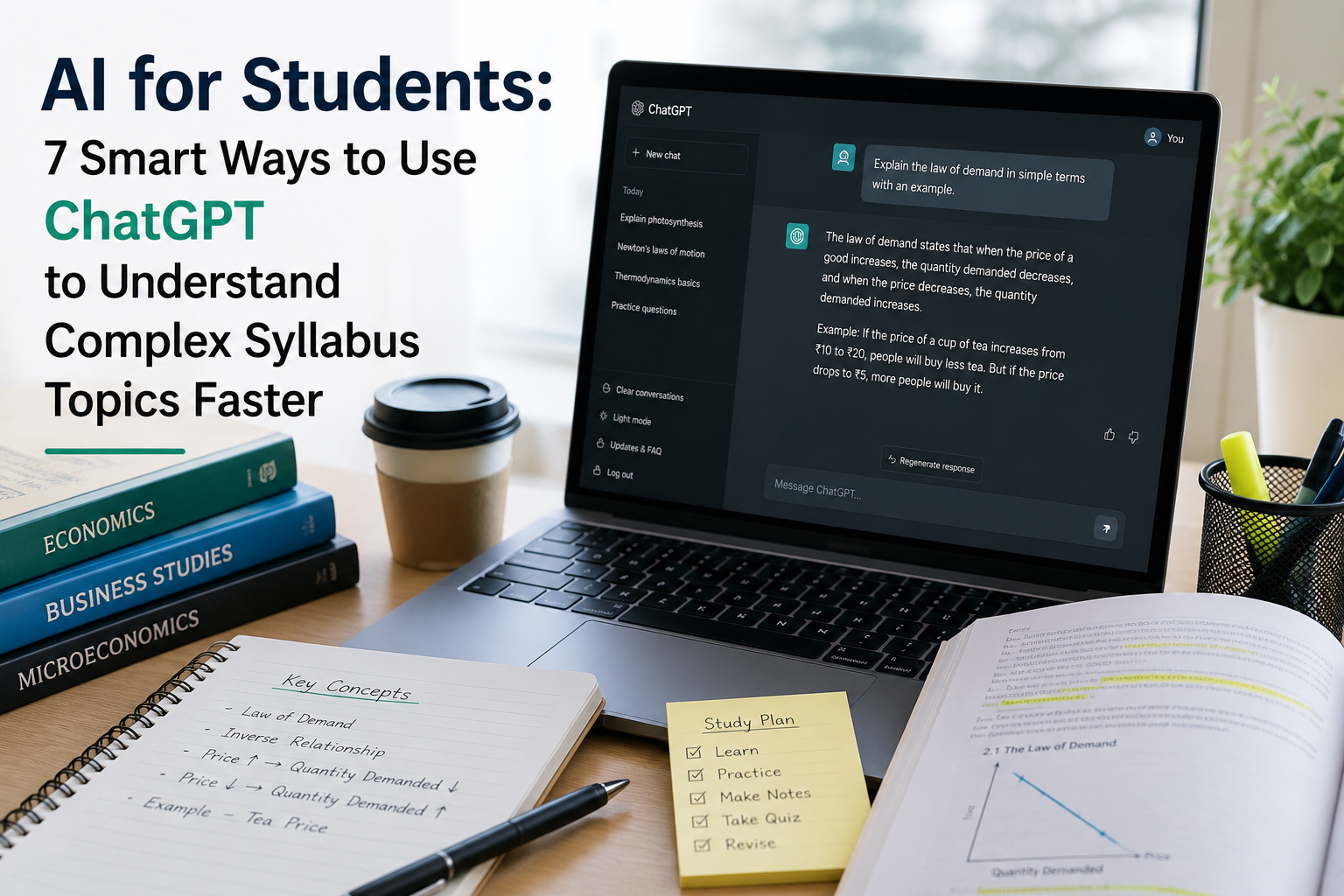
Around 11 p.m. Before an exam every student hits the same wall: a topic that just refuses to make sense no matter how many times you re-read the paragraph. I mean think about it. Organic chemistry mechanisms can be super confusing.
Same with GST input tax credit rules. And then there are those numerical problems involving Newtons laws that you've never seen before. You know that frustrating feeling.
Most students have started reaching for ChatGPT at that moment. But lets be real there's a difference between using it effectively and just typing "explain this chapter" and copying whatever comes back. I have put together this guide to share the prompts that actually work. I also look at where the line, between studying-with-AI and cheating sits.
I compare how ChatGPT stacks up against Gemini and Perplexity for this job.
Why Students Are Turning to AI Tools Right Now
This isn't a small trend anymore. Source Required A large and fast-growing share of Indian college students report using an AI chatbot at least once a week for coursework and the number keeps climbing every semester. Source Required
The honest reason isn't laziness. It's access. Not every student has a friend who's great at accounting, or a teacher who has time for one-on-one doubt sessions after 6 p.m. ChatGPT doesn't get tired of the same question asked five different ways, and that alone changes how students revise.
Quick framing
Think of ChatGPT as a study partner who has read everything but has no judgment about your subject — not a replacement for the thinking part. The tools in this guide are built around that idea.

7 Ways to Actually Use ChatGPT to Study Smarter
Each of these comes with a prompt you can copy directly. Swap in your own topic, subject, or course name.
Turn a Confusing Paragraph Into Plain Language:
Textbooks are usually written for people who already know about the topic, which's a pretty weird way to write a textbook. Sometimes you are reading a paragraph. It feels like it is fighting you.
When this happens with a textbook do not read the paragraph again and again. Just copy the paragraph, from the textbook. Ask AI to explain it to you in a different way.

Ask for a Real-Life Example, Not Just a Definition
Definitions are really hard to remember because they do not mean much on their own.
When you learn something that is related to economics or biology or programming and it is tied to something that happens in life you remember it much better.
This is what works when you are studying economics or biology or programming.

Build Revision Notes From a Long Chapter
Two nights before an exam is not the time to reread 40 pages. Have ChatGPT compress the chapter into the pieces you'll actually be tested on.

Ask the "Embarrassing" Questions
Every classroom has a question that nobody wants to ask out because it feels too simple. The thing about ChatGPT is that it does not remember what you asked before not your last five questions.
ChatGPT also does not have an opinion about whether your question's obvious or not. You can ask ChatGPT many times as you want and you can ask it in many different ways, as many times as you need to ask ChatGPT.

Test Yourself Before the Exam Does
Reading a chapter feels like progress. It usually isn't, on its own. The only way to know if something has actually stuck is to try and fail at recalling it — ideally a week before the exam, not during it.

Ask "Why," Not Just "What"
Memorized answers fall apart when you ask the question in a different way.. If you understand *why* something works that knowledge stays with you.
This is the change, between using AI just to memorize answers and using it to really learn something.

Build a Study Plan That Fits Your Actual Week
Most study plans fail because they are built for a week not the actual week with school classes traveling to and from places and all the other things that you have to do.
You should give ChatGPT your schedule with all the things that you have to do, like classes and commuting and everything else that is part of your daily routine. This way ChatGPT knows what your real week is, like, not some ideal version of it.
Give ChatGPT the constraints of your week.

A Real Worked Example: Understanding "Depreciation" for B.Com
Here's what this actually looks like end to end, using a topic almost every B.Com student struggles with at least once: depreciation in accounting.
- ✓Step 1: Paste the textbook definition and ask, "Explain depreciation like I'm running a small shop and buying a delivery bike for it."
- ✓Step 2: Ask for the straight-line method and written-down-value method compared side by side, with the same bike as the example in both.
- ✓Step 3: Ask "why does the written-down-value method show a bigger expense in year 1?" — this is the "why" question that actually gets tested.
- ✓Step 4: Request 3 numerical practice problems, solve them yourself first, then ask ChatGPT to check your working.
Notice what's happening here: the student is doing the thinking and the checking. ChatGPT is doing the explaining and the example-generating. That division is the entire difference between "studying smarter" and "outsourcing the exam."
Common Mistakes Students Make With AI Tools

Myth vs. Fact
Myth: "Using ChatGPT to study means I'm not really learning."
Fact: Using it to generate practice questions, get alternate explanations, or build revision notes is closer to using a tutor than to cheating — the learning still happens in your head, not the chat window.
Myth: "AI tools are always accurate, so I don't need to double-check."
Fact: AI chatbots can confidently state incorrect facts, outdated syllabus details, or wrong formulas. Always verify anything exam-critical against your textbook or professor.
Is Using ChatGPT to Study Considered Cheating?
This is the question underneath most of the guilt students feel about using AI tools and the honest answer is: it depends entirely on what you're using it for.

If you're unsure where your college draws the line, check your institution's academic integrity policy directly — many Indian universities have updated these specifically to address AI tools in the last two years.
ChatGPT vs Gemini vs Perplexity — Which Should You Use?
They're not identical tools, and picking the right one for the task actually matters.

Use ChatGPT to understand and revise. Use Perplexity when you need a source you can actually cite. Use Gemini when you're working directly inside a long PDF or a Google Doc.
Use AI as a Study Partner, Not a Shortcut
The students who benefit most from ChatGPT aren't the ones who ask it to do their work they're the ones who ask it better questions.
Use it to understand what confuses you, to test yourself honestly, and to plan your time realistically. Keep your textbooks, your professors, and your own thinking in the loop, and this becomes one of the most useful study tools available to you right now.
Frequently Asked Questions
- Is it okay for students to use ChatGPT to study?
Yes, when it's used to understand concepts, generate practice questions, or build revision notes. It becomes a problem only when it replaces your own thinking on graded work — see the comparison table above for where the line usually sits.
- Which is better for studying — ChatGPT, Gemini, or Perplexity?
ChatGPT is the strongest all-rounder for explaining concepts and building practice questions. Gemini is better for working inside long PDFs or Google Docs. Perplexity is best when you need a cited, current source for an assignment.
- Can my college detect if I used ChatGPT for an assignment?
Many Indian universities now use AI-detection tools alongside plagiarism checkers, and instructors are increasingly familiar with how AI-generated writing reads. Using AI to research or understand a topic is generally safe — submitting AI-written text as your own is the risky part.
- How do I make sure ChatGPT's answer is actually correct?
Cross-check anything exam-critical — formulas, dates, case laws, definitions — against your textbook or ask your professor. Treat ChatGPT's answer as a first draft of understanding, not a final source.